
Custom Rigid Boxes: The Complete Buyer’s Guide

Updated 2026
If you’ve ever opened an iPhone, a pair of luxury sunglasses, or a high-end candle. You now know exactly what a rigid box feels like.
That satisfying weight. The slow, smooth lift of the lid. The moment that tells your customer, before they even see the product, that they made the right decision.
That’s not an accident. That’s packaging doing its job.
This guide is going to walk you through everything you need to know about custom rigid boxes, what they are, the different styles, materials, finishes, pricing, minimum orders, and how to choose the right supplier. Whether you’re launching a brand new product or upgrading your current packaging to match the premium price tag you deserve, this is the only guide you’ll need.
Let’s get into it.
Table of Contents
- What Are Custom Rigid Boxes?
- How Are Rigid Boxes Made?
- Types of Rigid Boxes
- Rigid Box Styles Explained
- Materials & Construction
- Printing, Finishes & Add-Ons
- Custom Inserts for Rigid Boxes
- Rigid Boxes vs. Folding Cartons vs. Corrugated
- Who Should Use Rigid Boxes?
- How to Size a Rigid Box
- Rigid Box Pricing: What to Expect
- Minimum Order Quantities (MOQs)
- Lead Times
- Eco-Friendly Rigid Boxes
- How to Choose the Right Supplier
- Common Mistakes to Avoid
- Frequently Asked Questions
What Are Custom Rigid Boxes?
A rigid box (also called a set-up box) is a non-collapsible, high-end paper-based packaging solution made from thick chipboard typically 1.5mm to 3mm wrapped in a decorative specialty paper or fabric.
Unlike folding cartons that ship flat and get assembled, rigid boxes arrive pre-formed, pre-set, and ready to fill. That’s actually where the name “set-up box” comes from. They’re already set up for you.
The key characteristics of a rigid box:
- Thick chipboard core: doesn’t flex, crush, or collapse under normal use
- Wrapped exterior: specialty paper, fabric, or leather applied over the chipboard
- Premium appearance: matte, gloss, soft-touch, foil, embossed, and more
- Reusable by nature: customers keep them, which keeps your brand alive longer
Rigid boxes are everywhere in luxury markets: jewelry, cosmetics, electronics, spirits, watches, candles, subscription boxes, corporate gifts, and high-end apparel. When your product commands a premium price, your packaging needs to signal that premium before anyone sees what’s inside.
Quick Stat: Studies consistently show packaging has a direct effect on perceived product value. One survey found that 72% of consumers say packaging design influences their purchase decisions. For premium brands, that number is even higher.
How Are Rigid Boxes Made?
Here’s what happens behind the scenes when a rigid box is produced understanding this helps you make smarter decisions when customizing.
Step 1: Cutting & Scoring Chipboard (greyboard) is cut into flat panels and scored at fold points. The thickness of the chipboard usually 2mm or 3mm for full-finish boxes determines the structural integrity.
Step 2: Forming the Box The scored chipboard panels are folded and glued (or taped in partial-finish constructions) to form the base structure of the box. This is what makes it “rigid” is that it can’t be folded flat.
Step 3: Printing the Wrap A separate sheet of specialty paper (the “wrap”) is printed with your design, then laminated and finished. This is where the visual magic happens. Foil stamping, embossing, soft-touch laminate, spot UV are all applied to the wrap before it goes on the box.
Step 4: Wrapping & Assembly The printed wrap is glued around the chipboard structure. For full-finish boxes, this covers every surface inside and out. For partial-finish boxes, the interior chipboard edges may remain visible.
Step 5: Add-Ons & Quality Check Magnets, ribbons, inserts, and trays are added. Every box is quality checked before shipping.
Full Finish vs. Partial Finish
| Full Finish | Partial Finish | |
|---|---|---|
| Chipboard exposure | None, fully covered | Interior edges may show chipboard |
| Chipboard thickness | 2–3mm | 1–1.5mm |
| Cost | Higher | Lower |
| Best for | Premium, luxury, retail | E-commerce, cost-sensitive |
| Interior appearance | Clean, wrapped inside | Raw chipboard visible inside |
Most true luxury packaging uses full-finish construction. If you’re launching a high-ticket product, this is what you want.
Types of Rigid Boxes
Not all rigid boxes are the same. Here are the main construction types you’ll encounter:
1. Two-Piece (Lid & Base)

The classic. A separate lid sits on top of a base. The lid can be a full-depth cap or a shallow shoulder lid. This is the most common rigid box style. Think jewelry boxes, watch boxes and high-end cosmetics.
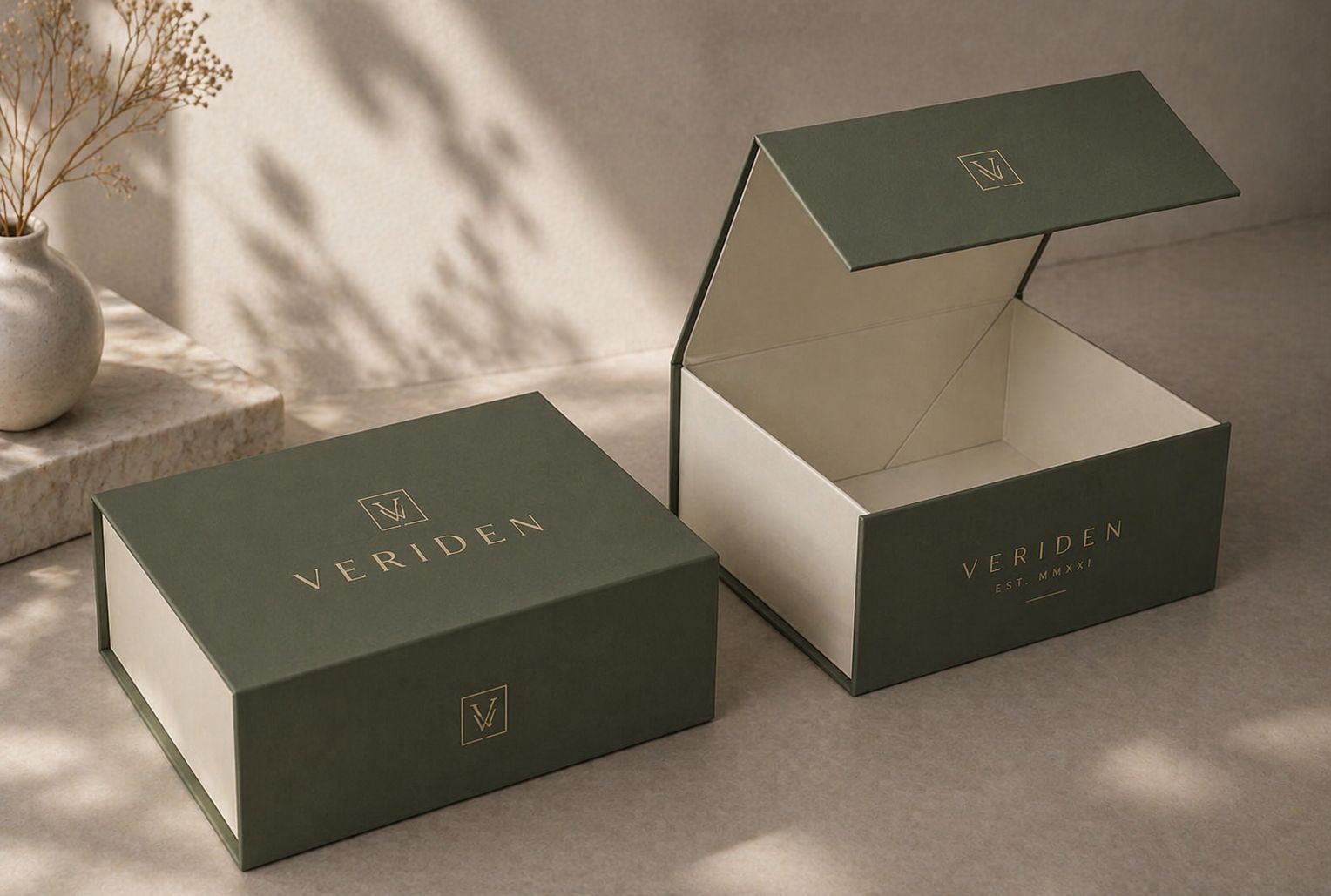
2. One-Piece (Hinged Lid)

The lid and base are connected with a hinge. Open it like a book or a clamshell. More convenient for the end user and very popular for electronics packaging (think AirPods, earbuds, tech accessories).
3. Foldable / Collapsible Rigid Boxes
This is one of the biggest innovations in rigid box packaging. These boxes have the structural integrity of a rigid box but fold flat for shipping, dramatically reducing freight costs and storage space. They use special magnet-and-tab closures to pop back into shape in seconds.
If you’re importing or ordering large quantities, collapsible rigid boxes can cut your shipping costs by 40–60%. Worth the extra conversation with your supplier.
4. Drawer (Sleeve & Tray)

A rigid outer sleeve that a tray slides in and out of, like a matchbox design. Great for perfume, cosmetics, tech accessories, and jewelry. Adds a tactile “reveal” moment to the unboxing.
5. Shoulder Box (Neck Box)
A two-piece box with an internal shoulder (neck) that allows the lid to sit at a specific height, giving the box a refined, layered appearance. Popular in cosmetics and spirits packaging.
6. Window Rigid Box

A rigid box with a die-cut window, usually covered with PET or acetate that lets the product show through. Great for confectionery, cosmetics, and any product where visibility drives purchase.
7. Custom Shape Rigid Boxes

Round, hexagonal, triangular, heart-shaped. If you can die-cut it, you can build it into a rigid box. Custom shapes are powerful brand differentiators but typically come at higher costs and longer lead times.
Rigid Box Styles Explained
Beyond construction types, you’ll also choose a closure and opening style:
- Telescope / Full Cap Lid: Lid fully covers the base. Classic luxury look. Preferred for gift packaging.
- Half-Telescope Lid: Lid covers only the top portion of the base. More affordable, still premium.
- Clamshell / Book-Style: Hinged box that opens like a book. Great for experience-focused packaging.
- Slide / Drawer: Tray slides out of sleeve. High tactile appeal.
- Magnetic Closure: Magnets embedded inside the flaps hold the box shut satisfyingly. One of the most popular closures for luxury packaging.
- Ribbon Pull / Tab: A ribbon or tab inside the base makes lifting the lid effortless and intentional.
Materials & Construction
The wrap material defines how your box looks, feels, and reflects your brand. Here are the most common options:
Specialty Papers
Art / Coated Paper The most widely used wrap material. Smooth surface, excellent for full-color printing. Available in matte, gloss, or silk finishes. Cost-effective without looking cheap.
Kraft Paper Unbleached, earthy, and sustainable-feeling. Increasingly popular with eco-conscious brands. Takes printing well. Gives an organic, handcrafted impression.
Textured / Linen Paper Woven or embossed texture baked into the paper itself. No need for embossing during post-print. The texture is structural. Adds tactile dimension and a premium hand-feel.
Pearlescent / Metallic Paper A subtle shimmer or metallic sheen in the base paper itself. Used in cosmetics, beauty, and jewelry packaging. Pairs well with foil and embossing.
Fabric & Premium Materials
Velvet Wrap Soft, luxurious, and instantly communicates premium. Used heavily in jewelry and high-end gifting.
Linen Wrap Natural, refined texture. Popular in spirits, fragrance, and artisan product packaging.
Leatherette / Faux Leather Sophisticated and durable. Common in premium tech accessories, cigars, and executive gifting.
Chipboard / Greyboard Core
The structural foundation. Quality chipboard is graded by thickness:
- 1–1.5mm: Lighter, more affordable, partial finish
- 2mm: Standard for most full-finish luxury boxes
- 3mm: Ultra-rigid, maximum structural integrity, highest-tier packaging
Printing, Finishes & Add-Ons
This is where your brand identity comes to life. The right combination of printing and finishes can make an $8 box feel like it cost $80.
Printing Methods
Offset Printing (CMYK) The standard for rigid box wraps. High color accuracy, works on large runs, cost-effective per unit at scale. Best for full-color designs with photos or gradients.
Digital Printing Lower setup costs. Ideal for shorter runs or multiple SKUs. Slightly less color depth than offset but improving every year.
Screen Printing Used for spot colors, especially on fabric wraps. Vivid, durable color application on non-paper surfaces.
Lamination Options
Lamination is applied to the printed wrap before it goes on the box. It affects durability and feel:
| Lamination Type | What It Does | Best For |
|---|---|---|
| Gloss Laminate | High shine, vivid colors | Consumer goods, cosmetics |
| Matte Laminate | Flat, elegant finish | Luxury, high-fashion, tech |
| Soft-Touch / Velvet Laminate | Silky peach-skin feel | Premium unboxing, apparel |
| Anti-Scratch Laminate | Resistant to scratches and fingerprints | Electronics, high-use boxes |
Specialty Finishes
Hot Foil Stamping Gold, silver, rose gold, holographic foil is applied to specific design areas using heat and pressure. Instantly signals luxury. Often used for brand logos, wordmarks, and borders.
Cold Foil A more cost-effective alternative to hot stamping. Applied using UV adhesive rather than heat, and integrated into the print process. Less tactile than hot foil but still highly effective.
Embossing Creates a raised 3D impression in the paper. Run your finger over a well-embossed logo and you’ll understand why customers love it.
Debossing The opposite of embossing where the design is pressed inward. Sleek, subtle, and elegant. Very popular in minimalist luxury packaging.
Spot UV A clear glossy coating applied to specific areas of a matte surface. Creates a dramatic contrast between the shiny and matte areas. Frequently used to highlight logos or graphic elements.
Soft Touch UV Same targeted application as spot UV, but with a velvety texture instead of gloss. Feels expensive.
Glitter / Textured Coating Adds depth, sparkle, or tactile texture to specific print areas. Popular in holiday and gifting packaging.
Custom Inserts for Rigid Boxes
The box is only half the story. The insert is where your product lives, and it protects your product while reinforcing the premium experience.
Insert Types
EVA Foam Inserts Dense, smooth, form-fitting foam. Ideal for jewelry, watches, electronics, and fragile items. Can be die-cut to any shape. Often flocked (velvet-coated) for a high-end finish.
Molded Pulp Inserts Eco-friendly option made from recycled paper pulp. Shaped to hold your product. Great for brands that want sustainability to be visible.
Thermoformed Plastic Inserts Clear or colored plastic vacuum-formed to product shape. Common in tech and cosmetics. Highly product-specific.
Rigid Paperboard Dividers Cardboard compartments that separate multiple products or SKUs in a single box. Common in multi-item gift sets and subscription boxes.
Satin / Fabric Lining The interior of the box (and/or lid) is lined with fabric, usually with satin, velvet, or microfiber. Creates an instant luxury feel when the box is opened. Popular for jewelry, watches, and premium gifts.
Corrugated Inserts For heavier, fragile products that need structural support during transit. Can be combined with outer rigid box for a dual-layer protection solution.
Pro Tip from Crateform: Don’t overlook the insert. Customers who feel like you thought about every detail of the experience are the ones who post their unboxing online, leave glowing reviews, and come back to buy again. The insert is your last impression.
Rigid Boxes vs. Folding Cartons vs. Corrugated
Still trying to decide if rigid is right for you? Here’s a direct comparison:
| Custom Rigid Boxes | Folding Cartons | Corrugated Boxes | |
|---|---|---|---|
| Structure | Non-collapsible, pre-formed | Flat-pack, assembled by brand | Flat-pack, assembled by brand |
| Sturdiness | Very High | Low–Medium | Medium–High |
| Luxury Perception | Very High | Medium (with good print) | Low–Medium |
| Cost | Higher | Lower | Lower |
| Minimum Orders | Typically 100–500+ | Lower, often 50+ | Lower, often 50+ |
| Lead Time | 15–30 days (standard) | 7–15 days | 7–14 days |
| Best Use Cases | Luxury goods, premium gifting, high-ticket products | Retail shelf, food, cosmetics, e-commerce | Shipping boxes, e-commerce, heavy goods |
| Reusable? | Yes , often kept by customer | Rarely | Occasionally |
| Eco-Friendly Options? | Yes | Yes | Yes |
The bottom line: If your product is priced above $30–40 and your brand identity is built on quality, rigid boxes are worth the investment. If you’re selling high-volume, lower-priced products, folding cartons or corrugated may be the smarter play.
Not sure which packaging format is right for your product? Explore Crateform’s full range of custom packaging options to compare.
Who Should Use Rigid Boxes?
Rigid boxes are the go-to for brands and products where the first impression is part of the value proposition. Here’s who uses them most:
Jewelry & Accessories The original rigid box use case. Rings, necklaces, bracelets, watches uses the box communicates the value of what’s inside before it’s even opened.
Luxury Cosmetics & Skincare Face serums, perfumes, high-end skincare collections need the box needs to match the $80+ price point you’re charging.
Electronics & Tech Accessories Apple famously uses premium packaging because they understand that the unboxing is part of the product experience. Earbuds, smart devices, phone accessories, and wearables all benefit from rigid packaging.
Spirits & Wine Premium whisky, gin, champagne, and wine brands use rigid boxes for gift sets and limited editions. Nothing says “gift-worthy” like a box that feels like it cost $50 alone.
Corporate Gifts & Branded Gifting Companies sending executive gifts, welcome kits, or branded merch to clients or employees want packaging that reflects the company’s professionalism and attention to detail.
Subscription Boxes Not all subscription boxes, but premium ones like beauty boxes, book clubs, and curated product subscriptions use rigid boxes to signal exclusivity and justify subscription fees.
Apparel & Footwear High-end sneakers, luxury apparel, cashmere and silk pieces. The box protects delicate items and doubles as display-worthy storage.
Candles & Home Goods Artisan candles and premium home decor brands use rigid packaging to create a luxury retail-at-home experience.
How to Size a Rigid Box
Getting the dimensions right is one of the most critical (and most often overlooked) steps. Here’s how to do it properly:
Step 1: Measure Your Product Measure the length, width, and height of your product at its widest points. If your product is irregular, measure its bounding box and ensure the smallest rectangle it fits in.
Step 2: Add Clearance Add 5–10mm (about ¼ inch) to each dimension for a snug but easy fit. If you’re adding an insert, account for insert thickness on all sides.
Step 3: Account for Insert Depth If your product sits in a foam or cardboard tray, add the tray wall thickness (usually 5–15mm) to each dimension.
Step 4: Lid Depth Decide how deep you want your lid relative to the base. Common ratios:
- Full Telescope: Lid height = 50% of base height (full coverage)
- Half Telescope: Lid height = 25–30% of base height
- Shoulder/Neck: Lid sits on a raised internal ledge
Step 5: Request a Sample Before ordering your full run, always request a paper mock-up or white sample from your supplier. This is a structural prototype printed in plain white so you can check sizing, feel the lid action, and confirm everything fits before committing to a full print run.
At Crateform, every custom project includes a structural sample before final production. Because getting the sizing right once is infinitely cheaper than reprinting 500 boxes.
Rigid Box Pricing: What to Expect
Let’s be direct about something: rigid boxes cost more than folding cartons or corrugated. That’s the trade-off. But when used correctly, they more than pay for themselves.
Factors that affect price:
- Size: Larger boxes require more chipboard and wrap material
- Finish: Full finish costs more than partial finish
- Wrap material: Standard art paper is cheapest; velvet and fabric are premium
- Print complexity: Number of colors, bleed coverage
- Finishes: Foil, embossing, soft-touch add cost per unit
- Insert type: Foam inserts cost more than paperboard dividers
- Magnet closures: Add cost but add perceived value significantly
- Quantity: More units = lower per-unit cost (see below)
Rough price ranges (per unit, as of 2025):
| Quantity | Simple Full-Finish | Mid-Range with Foil | Premium with Foam Insert |
|---|---|---|---|
| 100 units | $8–$14 | $12–$20 | $18–$30 |
| 500 units | $5–$9 | $8–$14 | $12–$20 |
| 1,000 units | $3–$6 | $5–$10 | $8–$15 |
| 5,000+ units | $1.50–$4 | $3–$7 | $5–$10 |
Note: These are general market ranges. Actual pricing depends on your specific design, dimensions, and supplier. Get a custom quote from Crateform for accurate pricing.
The ROI argument: If your product retails for $60 and your packaging costs $7 per unit, that’s roughly 12% of retail which is a completely standard range for premium goods. If the packaging increases your conversion rate by even 5% or reduces returns (because customers perceive more value and are happier with their purchase), it more than pays for itself.
Minimum Order Quantities (MOQs)
One of the most common friction points for small brands is MOQ. Here’s the landscape:
Typical MOQs across the industry:
- 100–250 units: Low MOQ, often at a price premium. Good for product launches, prototyping, and small businesses.
- 500 units: The sweet spot for most small-to-medium brands balancing cost per unit and cash flow.
- 1,000+ units: Price starts dropping significantly. Recommended once you’ve validated the product-packaging fit.
- 5,000+ units: Bulk pricing, deep discounts. For established brands with predictable demand.
A note on collapsible rigid boxes: Because they ship flat, they’re much easier to store in large quantities, which makes higher MOQs more manageable. If you’re ordering 1,000+ units, collapsible rigid boxes can reduce your warehousing headaches significantly.
At Crateform, we work with brands at all stages, from early-stage startups testing packaging designs to established brands ordering full container loads. Talk to us about your volume and we’ll find the right solution.
Lead Times
Rigid boxes take longer to produce than folding cartons. That’s just the reality of the construction process. Here’s what to plan for:
| Stage | Typical Timeline |
|---|---|
| Design approval & dieline finalization | 2–5 business days |
| Sample / white prototype | 7–10 business days |
| Sample approval | 1–3 business days |
| Production (after approval) | 10–20 business days |
| Shipping from overseas (sea freight) | 15–30 days |
| Shipping from overseas (air freight) | 3–7 days |
| Total (sea freight) | ~6–10 weeks |
| Total (air freight / rush) | ~3–5 weeks |
Plan accordingly. If you’re launching a product, build packaging into your timeline early, not after the product is ready. The number one reason brands end up with basic brown boxes at launch is that they didn’t start the packaging process soon enough.
Pro tip: Order a paper mock-up or structural sample the same day you finalize your dimensions. You can be refining the graphic design while the sample is in production, and both arrive at roughly the same time.
Eco-Friendly Rigid Boxes
Sustainability isn’t just a buzzword anymore. It’s a purchasing criterion for a growing segment of consumers. The good news: rigid boxes are already more sustainable than most packaging categories because customers keep them.
A box that gets reused as a storage container, keepsake box, or display piece has a much lower environmental footprint per use than a box that ends up in the recycling bin after 10 seconds.
Sustainable options to look for:
FSC-Certified Materials The Forest Stewardship Council (FSC) certification ensures that the paper and board in your packaging come from responsibly managed forests. Always request FSC-certified chipboard and wrap paper.
Recycled Content Greyboard (chipboard) made with high recycled fiber content which is typically 70–100% is widely available and performs identically to virgin board. Ask your supplier for their recycled content percentage.
Soy-Based Inks Lower VOC emissions than petroleum-based inks. Now standard with most quality printers.
Water-Based Coatings Water-based varnishes and coatings in place of UV coatings. Slightly less glossy, but recyclable and lower emissions.
Compostable Adhesives For brands doing zero-waste packaging, water-activated adhesives instead of solvent-based glues make the box fully compostable.
No Plastic Laminate Most lamination is plastic film. Water-based matte or gloss varnish can replace it in many applications while keeping the box fully recyclable.
How to Choose the Right Supplier
This is where most brands get tripped up. The packaging industry is full of suppliers making similar promises. Here’s how to evaluate them:
1. Do They Send Structural Samples?
Any credible rigid box supplier should send you a physical white sample or paper mock-up before production. If a supplier jumps straight to “approve the digital proof and we’ll print,” walk away. Rigid boxes have tolerances and tactile qualities that you simply cannot evaluate on a screen.
2. Transparent Pricing & Timelines
You shouldn’t have to chase down a quote for three days. Good suppliers give you clear pricing with itemized options (base price, foil add-on, insert add-on, etc.) and realistic lead times upfront.
3. Communication Speed & Quality
This matters more than it sounds. Packaging projects involve dielines, material samples, print proofs, and approvals. If your supplier takes 48–72 hours to respond to every email, your project is going to drag. Look for suppliers who respond same-day or next-day during business hours.
4. References & Past Work
Ask for a portfolio. Better yet, ask for customers you can contact. Any supplier confident in their work will have references willing to vouch for them.
5. Quality Control Process
Ask specifically: “How do you handle defects?” and “What’s your defect tolerance rate?” Good suppliers will have clear QC procedures and a policy for handling damaged or misprinted units.
6. Minimum Orders That Match Your Stage
If you’re ordering 200 units for a launch and a supplier’s MOQ is 1,000, that’s not the right fit right now, even if their quality is excellent. Find a supplier who meets you where you are.
7. Flexibility on Materials & Finishes
You should be able to request different wrap materials, finishes, and insert options – not be limited to a menu of pre-set choices.
Common Mistakes to Avoid
After helping hundreds of brands create custom packaging, these are the mistakes that come up over and over:
Mistake #1: Not ordering samples You’d be amazed how many brands approve a digital proof and order 1,000 boxes without ever holding the box in their hands. Always, always request a physical sample.
Mistake #2: Starting too late Rigid boxes take 6–10 weeks from design to doorstep. If you need boxes by a launch date, start the process 12 weeks out. Padding matters.
Mistake #3: Ignoring the interior The outside of the box gets all the attention, but the first thing your customer sees when they open it is the inside. A beautiful exterior with a bare grey chipboard interior is a missed opportunity.
Mistake #4: Undersizing the box Products that barely fit in their box look bad and stress the structural integrity of the walls. Aim for 5–10mm of clearance on all sides, more if you’re using an insert.
Mistake #5: Forgetting about shipping Rigid boxes are not shipping boxes. If you’re shipping direct-to-consumer, your rigid box needs to go inside a corrugated outer shipper. Plan for that extra cost and dimension in your logistics.
Mistake #6: Over-complicating the design More finishes is not always better. A clean design with one or two strategic finishes (matte laminate + hot foil logo) often lands harder than a box trying to do everything at once. Let the form do the talking.
Mistake #7: Choosing on price alone A supplier offering rigid boxes at 40% below market rate can be cutting corners somewhere in materials, labor, QC, or shipping speed. Quality rigid boxes have real costs. Focus on value, not the lowest price.
Frequently Asked Questions
What’s the difference between a rigid box and a setup box? They’re the same thing. “Setup box” is the older trade term because these boxes arrive already set up (pre-formed), versus folding cartons that need to be assembled. “Rigid box” is now more commonly used in retail and branding contexts.
Can rigid boxes be recycled? Yes, in most cases. The chipboard core and paper wrap are recyclable through standard paper recycling. If the box uses plastic laminate, it should be removed first (though in practice most consumers don’t). Water-based coatings and soy inks make the box more recyclable. Foam inserts are typically not recyclable through curbside programs.
How are rigid boxes shipped from the factory? Standard (non-collapsible) rigid boxes are nested or stacked and packed into corrugated master cartons. Because they can’t be folded flat, a large order can take up significant freight volume, which is one reason collapsible rigid boxes have grown in popularity. Collapsible versions ship flat and can dramatically reduce freight costs.
Can I order rigid boxes with my logo only, without full-color printing? Absolutely. Many premium brands use a simple wrap color (black, white, kraft) with a foil-stamped or debossed logo only. This minimalist approach is extremely popular and often more luxurious-looking than complex printed designs.
What file formats do I need to supply for printing? Most suppliers work with vector files in AI or PDF format, with fonts outlined and CMYK color mode. Dielines (structural cutting guides) are usually provided by the supplier. You apply your artwork to the dieline.
Do rigid boxes come with inserts included? Not by default. Inserts are a separate component and an additional cost. When you request a quote, always specify whether you need an insert and provide product dimensions so the supplier can design one that fits properly.
Can I get rigid boxes with magnets? Yes, magnetic closures are one of the most popular add-ons for rigid boxes. Magnets are embedded in the flaps or walls during construction and are invisible in the final product. They add a satisfying snap closure that customers love.
What’s the turnaround time for rush orders? Rush production (paying a premium for expedited factory time) plus air freight can typically get you boxes in 3–5 weeks from design approval. This adds cost but is doable for time-sensitive launches.
Can rigid boxes be used for food products? Yes, with caveats. The rigid box itself is not food-safe, but with a food-safe inner lining, bag, or insert, rigid boxes are commonly used for chocolates, confectionery, teas, and specialty foods. Always discuss food-safe requirements explicitly with your supplier.
How do I know what size box I need? Measure your product, add 5–10mm clearance on each side, account for insert thickness, and request a sample before ordering your full run. See the How to Size a Rigid Box section above for a step-by-step breakdown.
The Bottom Line
Custom rigid boxes are one of the highest-leverage investments you can make in your brand’s physical experience. They protect your product, elevate your perceived value, create shareable unboxing moments, and because customers keep them giving your brand a permanent presence in someone’s home.
The brands that win in premium markets don’t treat packaging as an afterthought. They treat it as part of the product.
If you’re ready to design packaging that earns its premium, Crateform is built to help you do exactly that with transparent pricing, physical samples before production, and a team that actually knows packaging.
Get a custom quote for your rigid boxes →
Related Reading:
- What Are Folding Cartons? The Complete Guide
- Corrugated vs. Rigid: Which Packaging Is Right for Your Product?
- The Complete Guide to Custom Packaging Finishes
- How to Design Custom Packaging: From Concept to Production
- Sustainable Packaging: Your Brand’s Green Packaging Options
- What Are Custom Inserts? Foam, Pulp, and More
- Custom Mailer Boxes: The Complete Buyer’s Guide
Last updated: 2026 | Written by the Crateform team. Questions? Contact us here.


